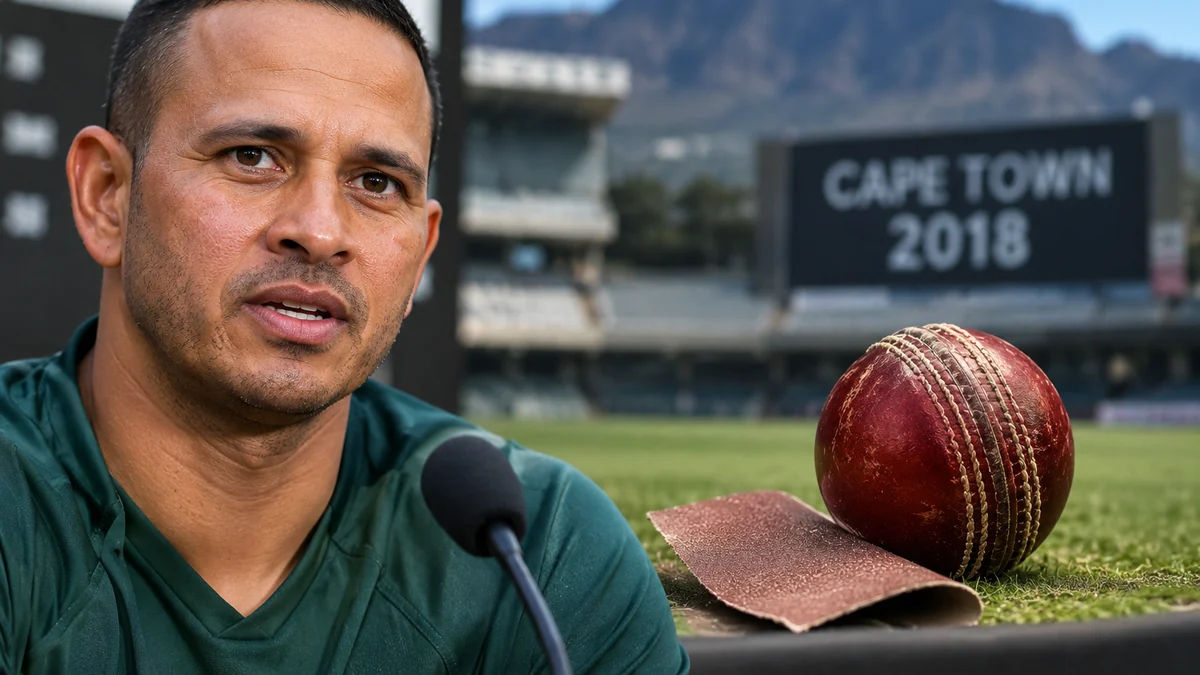
Former Australia batter Usman Khawaja has defended his revelations regarding the 2018 Cape Town ball-tampering scandal involving sandpaper. Speaking on social media, Khawaja insisted he has not thrown anyone under the bus and maintained that the entire squad shared collective responsibility.
Key Facts
- Usman Khawaja retired from international cricket in January after scoring 6,229 runs in 88 Tests.
- Khawaja claimed the entire Australia squad was aware of sandpaper use during the 2018 South Africa tour.
- Cricket Australia stated it remains satisfied with the findings of its original 2018 integrity investigation.
- Steve Smith, David Warner, and Cameron Bancroft were the only players sanctioned following the Cape Town Test.
Khawaja, who retired from international cricket in January after scoring 6,229 runs across 88 Tests, recently clarified his statements in videos posted on Instagram. The 39-year-old explained that his comments in his upcoming autobiography, titled Sabr, and an interview with the Sydney Morning Herald were meant to highlight shared accountability rather than single out specific individuals. He stated that whether team members like it or not, everyone involved on that tour bears responsibility for what transpired.
In his social media videos, Khawaja emphasised that he never spoke on behalf of anyone else in his book despite headline portrayals. He acknowledged that he made a promise to his childhood friend David Warner that he would tell the truth so Warner could share his side of the story. Khawaja noted that he remains entirely unapologetic for fulfilling that commitment, arguing that Warner, Steve Smith, and Cameron Bancroft deserve justice after taking the full public blame for the incident.
Khawaja revealed that he initially attempted to come clean alongside Smith in 2018 immediately after the Cape Town Test against South Africa. However, Smith insisted on taking the blame himself as team captain and talked Khawaja out of going public. Khawaja explained that he later considered speaking out again in 2021 after Bancroft indicated in an interview that it was self-explanatory that the bowling unit was aware of the plot.
Plans to address the matter in 2021 stalled when key team members issued a formal statement denying knowledge of any foreign substance, Sky Sports reported. Khawaja noted he held lengthy phone discussions with former coach Justin Langer and Australian Cricketers' Association chief executive Todd Greenberg at the time. He admitted he was uncomfortable going to war with his teammates while still an active player, choosing instead to wait until his words would no longer impact the team directly.
Khawaja also disclosed that the use of sandpaper had occurred prior to the famous Cape Town fixture. According to details in his autobiography cited by Wisden, the Australian squad discovered sandpaper was effective during the second Test in Port Elizabeth, now known as Gqeberha. Bancroft subsequently volunteered to use the abrasive material at St George's Park before being caught by television cameras during the third Test at Newlands.
Prior to the release of his book, Khawaja met with current Australian Test captain Pat Cummins in October. That meeting occurred ahead of Australia's recent Test tour of South Africa, which ended in a 2-1 series victory for the host country, BBC reported. Meanwhile, Darren Lehmann, who served as Australia's head coach during the 2018 tour before resigning, disputed Khawaja's assertions during an interview with ABC, stating he did not believe everyone in the camp was aware of the scheme.
Background
The Cape Town ball-tampering controversy broke in March 2018 when broadcast cameras caught Bancroft using sandpaper to alter the condition of the match ball. Following an investigation, Cricket Australia issued strict sanctions, banning captain Steve Smith and vice-captain David Warner from international and domestic cricket for 12 months, while Bancroft received a nine-month suspension. Warner was also handed a lifetime leadership ban, which governing body officials eventually overturned in 2024.
Cricket Australia's official findings at the time concluded that only Smith, Warner, and Bancroft had advance knowledge of the plan to alter the ball. In 2021, the core bowling attack from that match, comprising Pat Cummins, Mitchell Starc, Josh Hazlewood, and Nathan Lyon, released a joint statement asserting they did not know a foreign substance had been taken onto the field. Following Khawaja's recent disclosures, Cricket Australia stated it remains satisfied with the outcomes of its original integrity process while remaining open to any new relevant details.
Reacting to the ongoing discussion, Western Australia coach Beau Casson noted that Bancroft is focused on letting his performance speak for itself. Speaking after Bancroft scored 32 runs for Western Australia in a warm-up fixture against England in Perth, Casson remarked that the opening batter wants to move forward from the long-standing controversy. Bancroft has appeared in only two Test matches for Australia since his suspension, both during the 2019 Ashes series.
Why It Matters
Khawaja's revelations re-examine one of the most high-profile integrity crises in modern cricket, highlighting long-standing tensions surrounding collective accountability within national teams. The debate may prompt wider reflection across the sport regarding how governing bodies handle internal whistleblowing and player sanctions in multi-player compliance breaches.
Representative photo: ai generated