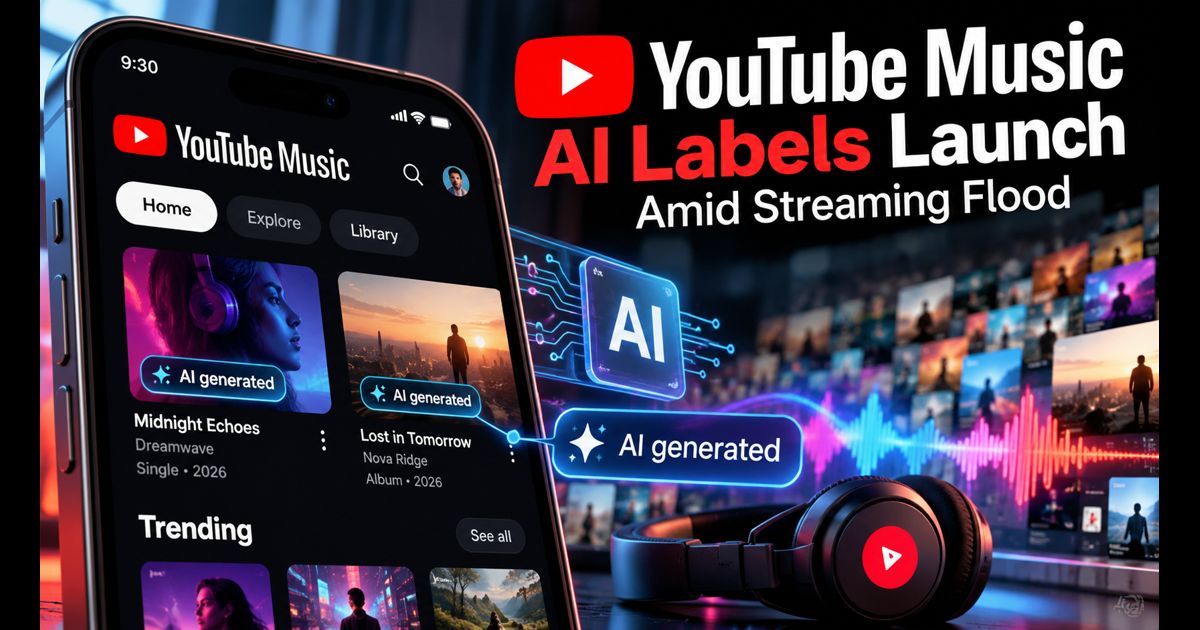
YouTube Music has announced the rollout of a fresh labeling system designed to boost transparency surrounding songs produced using generative artificial intelligence. According to reporting by TechCrunch, listeners will now be able to identify tracks built with AI involvement, covering elements like composition and vocals directly on the player page. Users can click on these indicators to view more details about how artificial intelligence was utilized in crafting the track. Furthermore, these tags will expand into the main YouTube application.
To build this system, YouTube stated it collaborated with various music partners and utilized its own detection technology to spot AI-generated audio. Based on help documentation from the platform, industry partners can classify their submissions using three distinct designations: Fully Gen AI, Partly Gen AI, or No Gen AI. The Fully Gen AI category covers works that are created entirely by artificial intelligence. Meanwhile, Partly Gen AI applies to compositions where human artists mixed in AI components alongside their own live recordings. Standard pitch-correction solutions, such as Auto-Tune, are classified under the No Gen AI category.
The initiative arrives as artificially generated music scales rapidly across digital streaming networks, prompting different platforms to establish their own policies. Apple Music has outlined plans for its own transparency tags later in the year, and Spotify maintains dedicated audio labels alongside filtering mechanisms for spam. Deezer has adopted a stricter posture, noting that it encountered tens of thousands of fully synthetic tracks on a daily basis, opting to exclude them from recommendations and withhold royalties. TIDAL also tags entirely synthetic recordings and removes them from royalty attribution.
What This Matters
Unlike competitors that restrict or withhold payouts from fully synthetic tracks, YouTube's approach centers heavily on disclosure rather than blanket penalties. Because artificial intelligence involvement alone does not disqualify a recording from monetization on the platform, creators and rights holders face a different commercial landscape. YouTube itself continues to experiment with generative audio tools like Dream Track, which allows select users to generate soundtracks using licensed artist voices. This dual strategy of encouraging experimentation while mandating user-facing disclosure highlights the complex balancing act streaming giants face as synthetic content rapidly alters the commercial music ecosystem.
Illustration: AI-generated image, not a photograph of the event.
Source: TechCrunch
Original source: https://techcrunch.com/2026/10/14/youtube-music-launches-new-labels-as-ai-generated-music-floods-streaming-platforms/