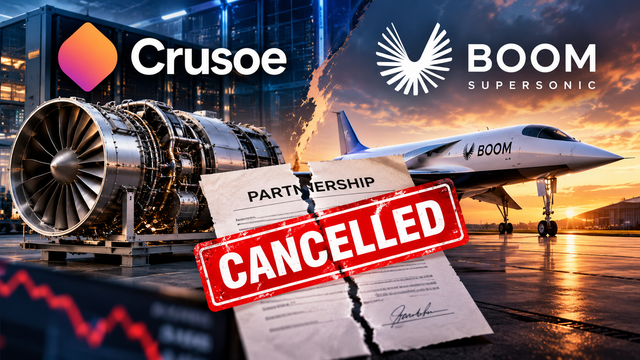
Denver-based artificial intelligence infrastructure company Crusoe has ended its ambitious $1.25 billion agreement to buy stationary power plants developed by aerospace developer Boom Supersonic. The cancellation, first reported by TechCrunch, represents a major shift in Crusoe's energy procurement strategy as the company continues to construct massive data center campuses across the United States.
The End of a Billion-Dollar Energy Deal
The original agreement positioned Crusoe as the launch customer for Boom Supersonic's newly established stationary power business. Crusoe had agreed to spend $1.25 billion to acquire 29 of Boom's "Superpower" turbines, which are 42-megawatt units designed to run on natural gas. These stationary generators share approximately 80 percent of their components with the "Symphony" engine, the propulsion system Boom is currently designing for its Overture supersonic passenger aircraft. Deliveries of the Superpower turbines were slated to begin in 2027.
That launch partnership has now been dissolved. Boom Supersonic Chief Executive Officer Blake Scholl announced the decision on the social media platform X. While congratulating Crusoe's co-founders, Chase Lochmiller and Cully Cavness, on their company's recent massive funding round, Scholl clarified that the two entities would no longer move forward with the turbine rollout. He explained that turbines are no longer part of Crusoe's immediate, primary power mix for its key locations like its campus in Abilene, Texas, making the launch partnership impractical at this stage.
Pivoting Energy and Aerospace Strategies
Crusoe has experienced rapid growth since its founding in 2018. Originally launched as a cryptocurrency mining firm that utilized excess natural gas from oil fields to run its operations, the company has successfully transitioned into one of the industry's most prominent developers of AI data centers. Crusoe recently raised $3.9 billion in funding and operates the massive Abilene computing campus, which supplies crucial processing power to artificial intelligence pioneer OpenAI.
In an email statement to TechCrunch, Crusoe spokesperson Andrew Schmitt confirmed that the partnership with Boom has ended. Schmitt noted that Crusoe designs and constructs its AI "factories" starting directly from the power infrastructure, requiring a highly flexible approach. As Crusoe's nationwide footprint expands, the company is choosing site-specific energy solutions, which may include solar, wind, batteries, traditional grid connections, or turbines depending on evolving requirements. He added that while Boom was a strong partner, the arrangement was no longer the right fit.
The loss of Crusoe as a primary launch customer is a significant commercial setback for Boom Supersonic. The aviation company, which raised $300 million last year to commercialize this stationary energy business, had planned to use the profits from its Superpower turbines to directly fund the costly development of its Overture supersonic airliner. Despite losing Crusoe, Scholl stated that Boom has other customers in its pipeline and still expects to deliver around 250 megawatts of Superpower capacity to other locations next year, with a broader goal of reaching 1 gigawatt of deliveries by 2028.
Why It Matters
The collapse of this partnership illustrates the intense, immediate pressure on artificial intelligence infrastructure builders to secure reliable electricity right now. High-performance computing campuses, such as the OpenAI-partnered facility in Abilene, require massive, uninterrupted baseload power. Crusoe's decision to pivot away from Boom's turbines to a more diverse and immediately available mix of solar, wind, batteries, and the power grid indicates that AI data center developers cannot afford to tie their expansion to long-term, unproven turbine commercialization timelines, even when those systems promise high capacity.
Additionally, this development reveals the vulnerability of cross-industry funding strategies. Boom Supersonic’s plan to utilize natural gas turbine sales to bankroll supersonic jet development was an unconventional attempt to hedge the massive capital costs of aerospace engineering. With its flagship buyer withdrawing, Boom must now prove to its remaining pipeline customers and investors that its stationary power units can succeed in the open market without the backing of a major AI hyper-scaler.
Source: TechCrunch
Original source: https://techcrunch.com/2026/09/25/crusoe-abandons-1-25b-plan-to-use-boom-turbines-at-ai-data-centers/